
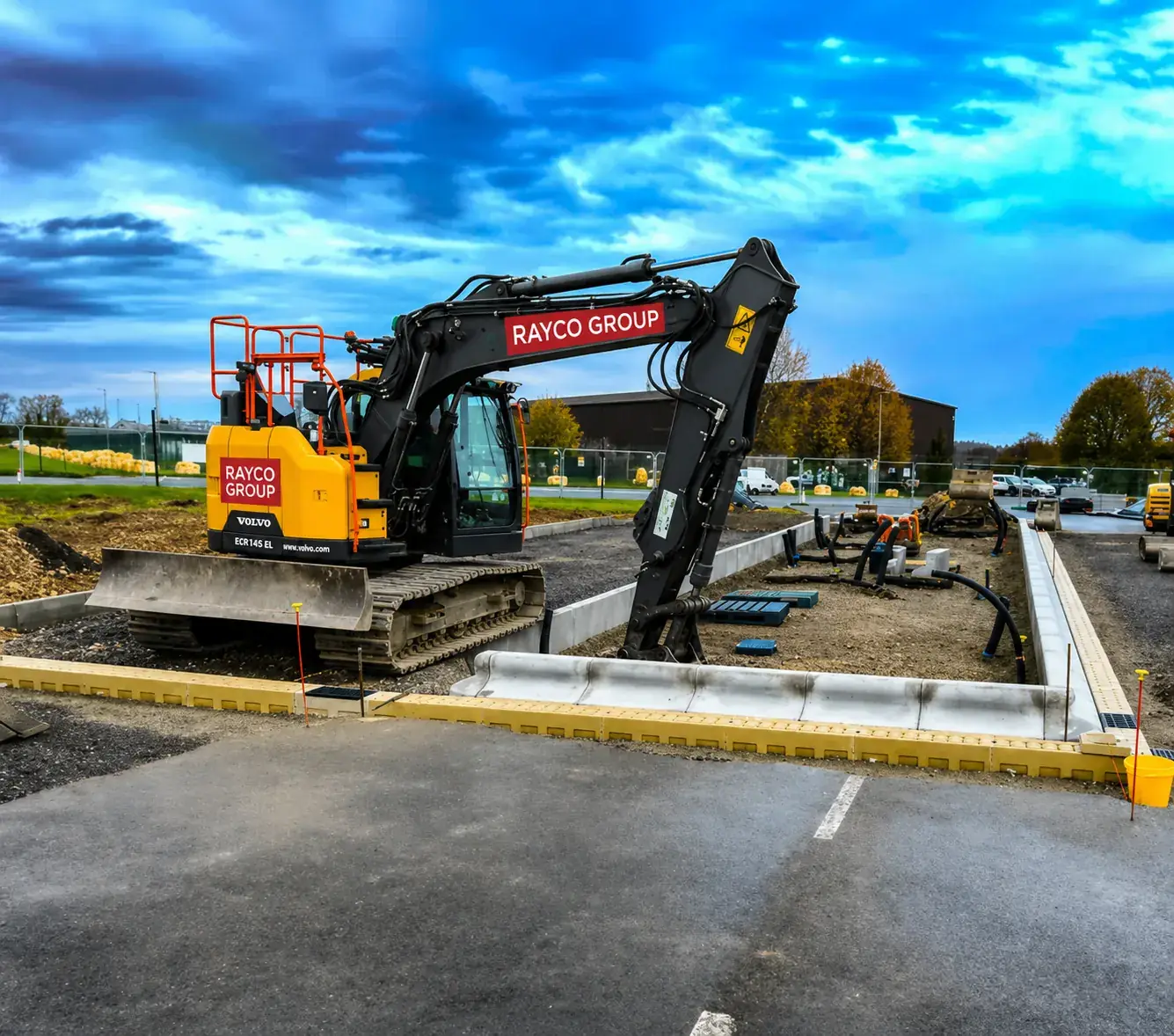
Basement and Bulk Basement Excavation in Ireland
Basement excavation is the deep bulk dig that takes a site below existing ground level to a designed basement formation. It covers setting out, staged excavation with safe batters or engineered support, groundwater control, rock breaking where required, and muck-away of spoil to licensed facilities.
Overview
A basement dig is the highest-risk earthworks operation on most sites. The excavation goes below the level of neighbouring ground, foundations and services, so the sequence, the batter profile or support system, and the way water is handled all have to be worked out before the machine starts rather than adjusted afterwards.
Rayco Civils carries out bulk basement excavation on residential, commercial and industrial sites across Ireland — reduced-level and deep dig to formation, staged excavation to the engineer's temporary works detail, rock breaking through bedrock, dewatering of the dig, and cart-away or on-site re-use of arisings.
Rayco Civils is a civil engineering and groundworks contractor based in Monamolin, Co. Wexford, working on sites across Ireland. Send drawings or a site location and we will price the works.
Scope of works
Volumes and levels come off the drawings
Bulk basement excavation is priced and programmed off the engineer's cut-and-fill and basement drawings, not estimated on site. Dig volumes, formation levels, over-dig allowance for blinding and drainage, and the split between material suitable for re-use and material for disposal are all established before we mobilise.
That matters most on tight urban sites, where lorry movements, wheel wash and the number of loads per day set the programme as much as the machine capacity does.
Support, batters and adjoining ground
Where there is room, the dig is battered back to a safe profile in stages and the excavation is kept stable by geometry. Where boundaries, roads or neighbouring foundations are close, the excavation follows a designed temporary works scheme — sheet piling, secant walls, contiguous piling or propping — installed by the specialist and dug to in the sequence the engineer specifies.
We do not deviate from that sequence to speed a dig up. Sequence and lift depth are what keep the excavation and the ground beside it safe.
Water and rock are the two usual surprises
Below the water table, the dig has to be kept dry with sumps and pumps so the formation is not softened, and discharge has to be settled before it leaves the site. On rock sites the dig stops being a digging operation and becomes a breaking one, with hydraulic hammers and, where suitable, crushing of broken rock for re-use as fill.
Both change the rate of progress considerably, which is why site investigation information is worth having in front of us at pricing stage.
Handover to the structure
The dig is finished by trimming the formation, proof rolling or inspecting the bearing stratum with the engineer, and placing blinding and any drainage layer so that the waterproofing and slab can follow immediately. Basement excavation handed over clean and at the correct level saves the structural programme far more time than a fast, rough dig ever gains.
Frequently asked questions
What is bulk basement excavation?
It is the large-volume dig that takes a site down to a designed basement formation level — staged excavation, spoil removal and formation preparation — as distinct from the smaller trench dig for foundations or drainage.
How deep can you excavate?
Depth is set by the design and the ground rather than the plant. Shallow single-storey basements are dug on battered profiles; deeper digs and digs close to boundaries are carried out to an engineer's temporary works design with piling or propping installed by the specialist.
What happens if we hit rock?
Excavation switches to hydraulic hammer breaking. Broken rock is often crushed and re-used as fill on site where it is suitable, which reduces both import and muck-away costs.
Do you deal with groundwater in the excavation?
Yes. Sumps and pumps keep the dig workable and protect the formation from softening, with discharge settled before it leaves site. Permanent groundwater management is designed by the engineer as part of the basement waterproofing.
Where in Ireland do you carry out basement excavation?
Nationwide from our base in Monamolin, Co. Wexford — Dublin, Wicklow, Kildare, Meath, Carlow, Kilkenny, Waterford, Cork and beyond.
Explore Civil Works Across Ireland
Jump straight to your service, county, or the exact combination you need.
Most Requested Pages
Services
- Groundworks Ireland
- Foundations Ireland
- Drainage & Ducting Ireland
- Concrete Works Ireland
- Site Clearance Ireland
- Roadworks & Kerbing Ireland
- Excavation Ireland
- Earthworks Ireland
- Site Development Ireland
- Utility Installation & Ducting Ireland
- Kerbing & Footpaths Ireland
- Car Parks & Hard Standings Ireland
- Drainage Repairs Ireland
- Land Clearance Ireland
- Rock Breaking Ireland
- Concrete Slabs & Bases Ireland
- Farm Groundworks Ireland
- Retaining Walls Ireland
- Bulk Excavation Ireland
- Road Repairs Ireland
Priority Counties
Specialist Civil Works Pages
Groundworks by Town
Talk to Rayco Civils
Send your drawings or site location for a free, no-obligation quotation anywhere in Ireland.